
We may earn money or products from the companies mentioned in this post.
You want an under-sink water filter that addresses your water concern without buying a system that needs more cabinet space, plumbing changes, or replacement parts than you expected. Aquasana and Waterdrop sell different kinds of systems, so a brand name alone will not settle the choice.
The useful shortlist is narrower: compare the Waterdrop 10UA if you want filtration through your existing cold-water faucet, the Aquasana Claryum 3-Stage Max Flow if you want a dedicated filtered-water tap, and the Waterdrop G3P800 if you have established a reason to choose reverse osmosis. Your water information and the exact model’s documented reductions come first.
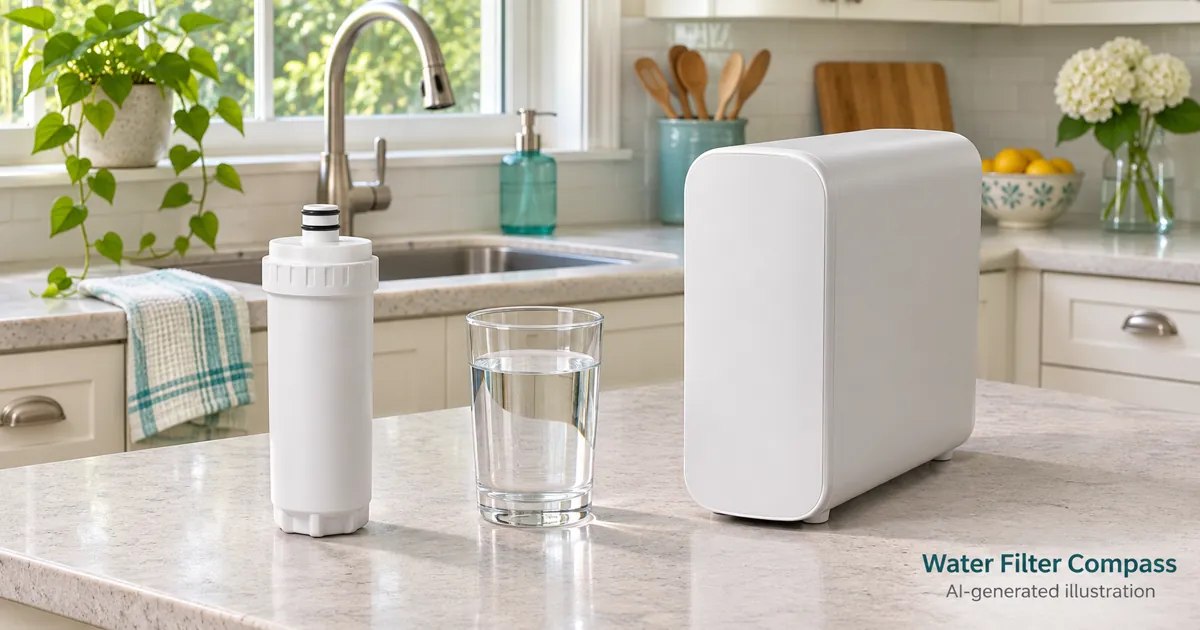
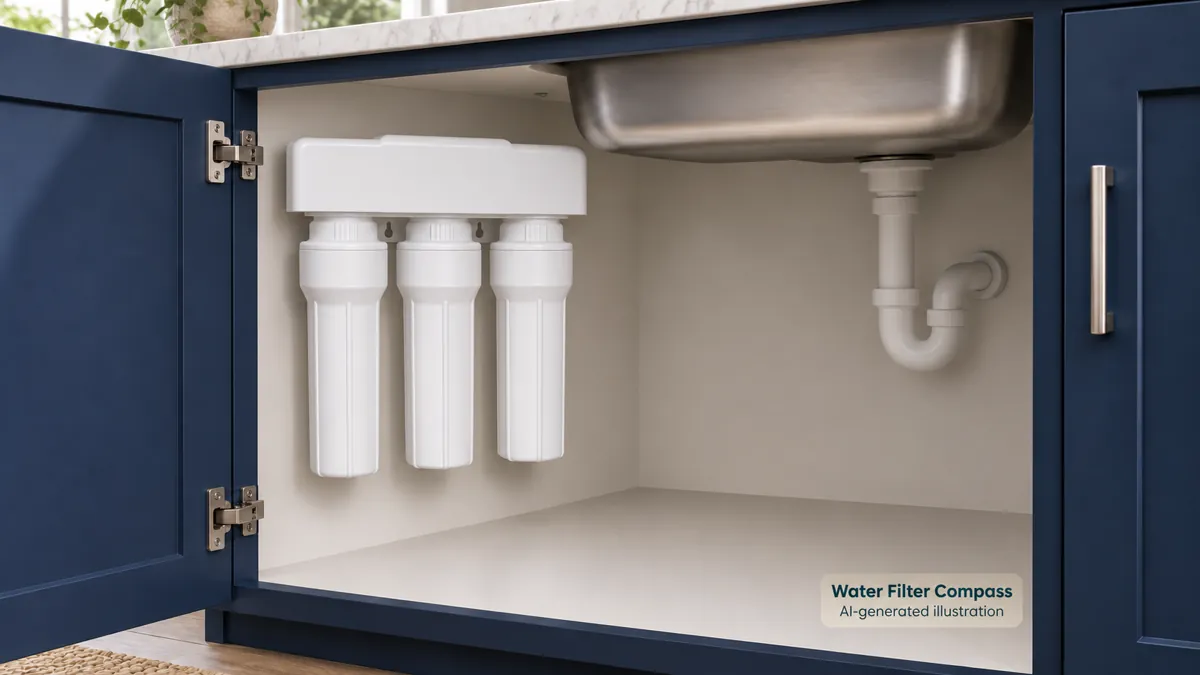
Research disclosure: We have not installed or tested these products. This guide compares manufacturer documentation and retailer listings identified on November 3, 2026. The “best fit” descriptions below are editorial judgments about installation and ownership, not results from hands-on testing. Illustrations show generic equipment, not exact product photographs.
Affiliate disclosure: As an Amazon Associate, I earn from qualifying purchases.
Quick shortlist: choose the installation you can live with
| Option | Best fit to investigate | Main trade-off |
|---|---|---|
| Waterdrop 10UA | An existing cold-water faucet and a simple single-cartridge arrangement | Not reverse osmosis; check the scope of each reduction claim |
| Aquasana Claryum Max Flow AQ-6300M | A separate drinking-water tap with selective filtration | Requires faucet provision and scheduled filter-set changes |
| Waterdrop G3P800 | A tankless RO installation with suitable power and drain access | More service parts, reject water, and an electrical requirement |
| Aquasana OptimH2O AQ-RO-3 | Existing owners checking replacement compatibility | Current new-system availability was not verified; see the owner note below |
Our starting point: For a homeowner who wants to keep the existing faucet and is primarily investigating chlorine taste and odor, the 10UA is the first installation style to consider. If its documented claims do not cover your concern, move to the other options rather than treating that convenience as a reason to compromise on treatment needs.
Still deciding which treatment category you need? Read our Claryum versus reverse-osmosis guide. This article focuses on picking certain products, faucet arrangements, and replacement commitments.
1. Waterdrop 10UA: first to compare for an existing faucet
The Waterdrop direct-connect range includes several sizes. This section refers specifically to WD-10UA, not the 15UA, 17UA, or 10UA PRO. Similar names do not establish identical cartridges or performance.
Its attraction is the arrangement: filtration on the cold-water supply serving your existing faucet. That avoids the need to add a second drinking-water tap. The product documentation lists a replacement interval of up to 12 months or 11,000 gallons for the 10UA; use the earlier limit and follow the instructions supplied with your cartridge.
What makes it a useful candidate
Start here when you want a simple installation and have a treatment goal covered by the exact model’s evidence. Record the replacement cartridge number before ordering so you can check its availability and current price, not just the starter system’s price.
Remember that an inline arrangement also filters the cold water used at that faucet for tasks other than drinking. Your cartridge budget should reflect how you actually use the sink.
What to check before buying
Waterdrop identifies NSF/ANSI 42 and 372 certification on the range page. Standard 372 concerns lead content in materials; it does not by itself establish lead-removal performance. The page also makes third-party laboratory reduction claims. Keep those separate from a specific certified claim, and request the matching performance sheet if your purchase depends on lead, PFAS, or another substance.
This is not a substitute for an RO membrane when your goal is substantial dissolved-solids reduction. Also check the current instructions for permitted source water, fittings, and chilled-water use. Do not assume a compact filter makes untreated well water suitable for drinking.
2. Aquasana Claryum Max Flow: compare for a dedicated tap
The Claryum 3-Stage Max Flow AQ-6300M uses a separate drinking-water faucet. Aquasana lists a rated service flow of 0.72 gallons per minute and a filter set limit of 6 months or 800 gallons. These are manufacturer ratings, not measurements from our kitchen.
Its selective-filtration approach safeguards naturally occurring minerals. Broad TDS reduction and fluoride reduction are not reasons to choose this model. Match your concern to the model-specific performance data sheet rather than assuming every Aquasana system does the same job.
Where the layout earns its place
A dedicated tap lets you reserve that filtered-water outlet for drinking and cooking while keeping ordinary sink tasks on the main faucet. That can be convenient if you would rather not send every cold-water use through a drinking-water cartridge.
However, a suitable countertop or sink opening for the dedicated faucet and usable cartridge-change space are required for installation. Confirm the faucet finish and exact package, particularly when a retailer offers several similar listings.
The continuous commitment
Aquasana’s replacement listing showed US$91.99 for the standard Max Flow filter set when checked. Two sets at that price total US$183.98. This is an illustrative annual replacement budget at a six-month schedule, excluding tax, shipping, installation, and other service items; discounts and actual replacement needs can change it.
Our full Claryum Max Flow review covers this product in more detail. Compare that ownership commitment before deciding that its initial sale price is your complete cost.
3. Waterdrop G3P800: compare when RO is justified
The Waterdrop G3P800 is a tankless reverse-osmosis system. The manufacturer lists an 800-GPD rating, a dedicated smart faucet, electrical power, and drain hardware. “Tankless” removes a storage-tank requirement; it does not remove installation requirements.
Waterdrop lists a 3:1 purified-water-to-drain ratio. That wording means three parts treated water to one part reject water under the applicable conditions. It is not three gallons wasted per gallon produced, nor is it a promise about your household’s measured use.
Who should investigate it?
Consider this model when you need an RO capability supported by the exact product’s current documentation and have room, power, and drain access. Check the performance sheet for the particular substance you want reduced, rather than choosing it for the largest stage count or a screen on the faucet.
The 800-GPD figure describes rated production under test conditions. It is not the quantity your family needs to drink, nor a guarantee of your actual tap flow. A TDS display also cannot identify which contaminants are present.
Filter costs and a documentation issue to resolve
The manufacturer page listed CF, CB, and RO replacement prices of US$29.99, US$29.99, and US$139.99, with nominal intervals of six, 12, and 24 months. Annualizing two CF filters, one CB filter, and half an RO membrane gives approximately US$159.97 per year, before tax, shipping, water, electricity, or optional filters. This is a budgeting calculation, not a first-year bill.
One detail needs confirmation before purchase: the page’s RO replacement card and FAQ show different gallon limits. Ask Waterdrop for the current manual and cartridge-specific limit for the exact package. Follow the earlier applicable time or capacity limit; do not resolve conflicting instructions by choosing the longer life.
Already own an Aquasana OptimH2O? Check AQ-RO-3 parts
The saved research also included Aquasana’s OptimH2O Reverse Osmosis + Claryum AQ-RO-3. Aquasana still provides its manual and replacement listings, but this research did not verify a current new-system offer. It is included here for owners and shoppers encountering older listings, not ranked as a confirmed current purchase.
The official AQ-RO3-R replacement page identifies the Carbon and Claryum set for that system. Aquasana’s manual directory separately lists OptimH2O, SmartFlow, and HealthShield models. Use the model on your unit to identify compatible parts.
Before buying old stock, obtain written confirmation of warranty coverage, included components, and availability of replacements. A familiar Aquasana name is not sufficient evidence that a SmartFlow part fits an OptimH2O system.
Measure these five things before ordering
- Faucet provision: Existing tap, spare opening, or permission and a quote for a new opening.
- Working clearance: Space for the unit plus access to remove cartridges, not just room to close the cabinet.
- Supply fittings: Match the valve and tubing arrangement to the exact manual.
- RO services: Confirm the permitted drain connection and, for the G3P800, a suitable electrical supply.
- Service access: Keep the shutoff accessible, and check whether the disposal or cleaning supplies block access for maintenance.
Give an installer photographs of your actual cabinet before requesting a price. If you rent, establish what changes are permitted before ordering equipment. No installation-time estimate on a sales page can account for every kitchen.
Compare ownership costs on the same basis.
| Cost to record | What to include |
|---|---|
| Purchase | The exact unit, faucet finish, first filter set, and any optional stages |
| Installation | Plumbing, countertop work, fittings, and power provision where needed |
| Replacement parts | Correct cartridge codes, time limits, gallon limits, and ordinary one-time prices |
| RO operation | Reject water, flushing, and applicable electricity or sewer costs |
| Longer ownership | Warranty terms, service items, and availability of replacement housings or electronics |
Keep U.S. dollar and Canadian dollar quotes separate. Confirm shipping destination and currency before comparing them. A subscription discount is useful only if its conditions and future price work for you.
A buying checklist for U.S. and Canadian households
For U.S. public-water customers, begin with your utility’s Consumer Confidence Report. Private-well owners should use appropriate testing and local advice; CDC’s well-testing guidance explains where to start.
Canadian readers can consult their supplier and local public health service, as well as Health Canada’s treatment guidance. A system-wide report provides context; questions about your own plumbing may require a separate tap water test.
Write down one sentence before shopping: “I need a documented reduction of ___, and my kitchen permits ___.” Then reject any candidate that fails either half. If you do not yet know what needs treatment, resolve that first rather than buying the most elaborate option.
Frequently asked questions
Is the Waterdrop 10UA the same as the G3P800?
No. The 10UA is a direct-connect non-RO option, while the G3P800 is a powered tankless RO system. Their treatment process, faucet arrangement, service needs, and replacement parts differ.
Which choice avoids a second faucet?
The 10UA is the existing-faucet option in this shortlist. The Claryum Max Flow package and G3P800 use dedicated drinking-water faucets. Check your exact package and manual before purchase.
Does NSF/ANSI 372 mean a filter removes lead?
No. It concerns lead content in the product’s materials. A lead-reduction claim needs its own supporting performance evidence. NSF’s standards guide explains why the standard number and named claim matter.
Which one should I buy?
Start with the 10UA for an existing-faucet arrangement, Max Flow for selective filtration through a separate tap, or G3P800 for a documented RO need. Those are starting points, not universal recommendations. Verify the precise reduction claim, installation fit, and replacement budget before making a choice.
Your next step
Shortlist the installation you can maintain, then compare the exact product documentation and current package. For options beyond under-sink systems, see our home water filter buying guide. For the technology decision, use our Claryum versus RO comparison.
Sources and research notes
- Waterdrop direct-connect range: identify WD-10UA specifically
- Aquasana Claryum Max Flow model and specifications
- Aquasana replacement filter listings and prices
- Waterdrop G3P800 specifications and replacement listings
- Aquasana model-specific manuals
- NSF: water-treatment standards
Documentation and manufacturer replacement prices checked November 3, 2026. Prices, packages, and instructions can change. Retailer links identify products; they do not establish certification. See our editorial policy for our research approach.