
We may earn money or products from the companies mentioned in this post.
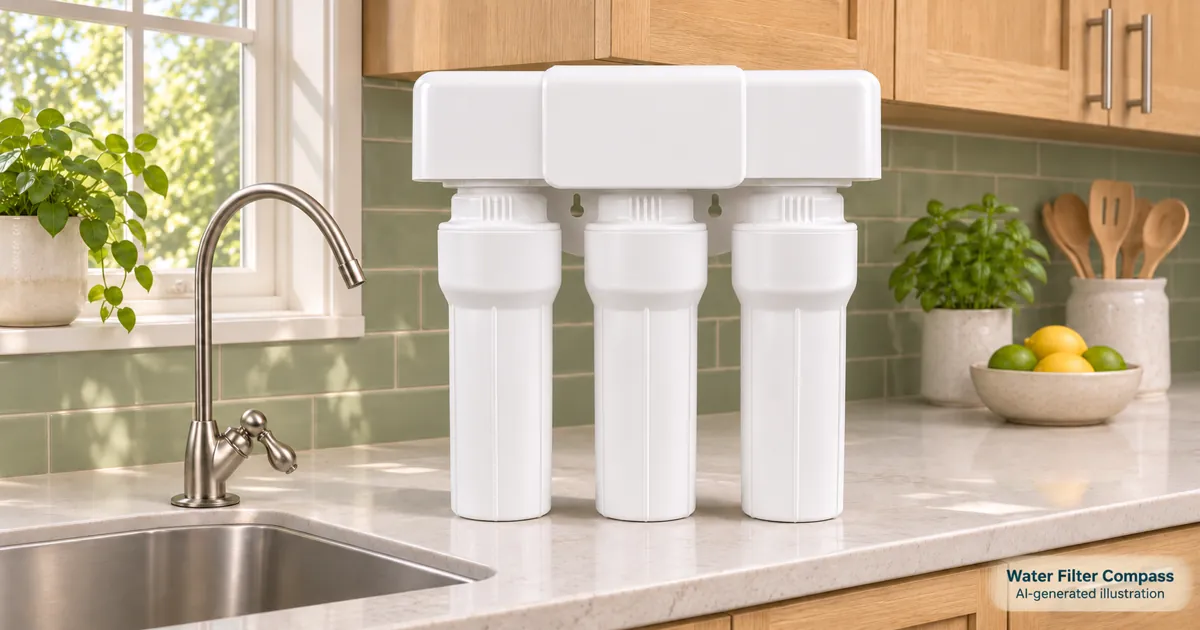
You are ready to buy an under-sink filter, but one question can change the entire purchase: do you need reverse osmosis, or will Aquasana Claryum cover the substances you want reduced? The answer affects cabinet space, installation, replacement parts, and water use.
Choose Claryum only when the exact model’s documented reductions match your water concerns. Compare reverse osmosis when you need a documented reduction that Claryum does not offer, such as fluoride or broader dissolved-solids reduction. Neither label replaces checking the specific system.
Research disclosure: We have not installed or tested these systems. This comparison uses manufacturer documentation and guidance from CDC, EPA, Health Canada, and NSF, checked November 3, 2026. Our recommendations are based on treatment goals and ownership requirements, not measured performance in our own home.
As an Amazon Associate, I earn from qualifying purchases.
Quick comparison: Claryum Max Flow vs under-sink RO
This article uses the Aquasana Claryum 3-Stage Max Flow (model AQ-6300M) as the non-RO example. Reverse osmosis is a treatment category with many configurations, so its column is a buying checklist rather than a specification for one product.
| Buying question | Claryum 3-Stage Max Flow | Under-sink reverse osmosis |
|---|---|---|
| What should drive the choice? | Its listed contaminant-reduction claims | The exact RO system’s reduction claims |
| Does it target broad TDS reduction? | No; selective filtration retains naturally occurring minerals | An RO membrane reduces dissolved solids; check rated performance |
| Is fluoride reduction documented? | Not listed on the AQ-6300M performance sheet | Available on some certified models; verify the claim |
| What fills the cabinet? | Filter assembly and tubing, with a dedicated faucet | Filter assembly plus a tank or tankless unit; layout varies |
| What ongoing parts need budgeting? | Scheduled filter sets and other service items in the manual | Prefilters, membrane, postfilters, and optional remineralizer |
| What water-use detail matters? | Flushing requirements | Reject water as well as flushing |
For the complete product-specific assessment, see our Aquasana Claryum Max Flow review. To compare pitchers, countertop units, and whole-house treatment too, start with our home water filter buying guide.
Start with your water report or test results.
For U.S. readers on public water: Start with your utility’s annual Consumer Confidence Report, also called a drinking water quality report. It describes your water source, detected regulated contaminants, and any reported violations. Request a copy from your water supplier or use EPA’s Consumer Confidence Report resources.
For U.S. private-well owners: Use a state-certified laboratory. CDC recommends testing well water at least once a year for total coliform bacteria, nitrates, total dissolved solids, and pH. Ask your local health department which additional tests are appropriate for your area and whether you need to test more often.
For Canadian readers: Health Canada explains that additional health-related treatment is generally unnecessary when community water meets its drinking-water guidelines. It recommends regular testing for individual supplies such as wells. That is a useful reminder to establish a reason for treatment before choosing equipment.
Write down your actual concern: chlorine taste, lead at your tap, fluoride, nitrate, or something else. A utility report provides context, while testing may be needed to answer questions about water at your property. Ask your local public health service which tests are appropriate for your supply.
For example, a homeowner concerned about chlorine taste and a documented lead issue should compare those specific reduction claims. A buyer seeking fluoride reduction needs a different evidence check. Buying a more elaborate system without specifying the treatment goal makes it harder to judge whether the extra cost is worth it.
What Claryum does, and what it does not
Aquasana describes Claryum as a selective filtration system that uses several treatment methods. Its Max Flow product documentation states that naturally occurring minerals, such as calcium and magnesium, remain in the water. This differs from an RO membrane’s broader reduction of dissolved solids.
The AQ-6300M performance data sheet lists reductions for substances including chlorine, chloramine, lead, and PFOA/PFOS under certain test conditions. It has a rated capacity of 800 gallons and a flow rate of 0.72 gallons per minute. Laboratory ratings are not measurements of your kitchen’s performance.
Fluoride and broad TDS reduction are not listed claims on that sheet. If either is your main objective, do not buy this model expecting it to solve that problem. A low TDS reading is also not a substitute for a test for an individual contaminant.
This makes Claryum worth comparing when its documented claims cover your needs, and you want to retain the existing mineral profile. It does not make mineral retention a health advantage or establish that the system is appropriate for every water supply.
When reverse osmosis deserves a closer look
CDC’s filter-selection guidance explains that RO can reduce some dissolved chemicals, including sodium and chloride, and may reduce others such as fluoride, arsenic, and nitrate. It specifically advises checking the product label to see which chemicals the filter can remove.
That is the key distinction: RO opens another set of treatment options, but a generic “reverse osmosis” description is not evidence for every substance. Read the current performance sheet for the precise model, its required replacement cartridges, and any feed-water restrictions.
RO also reduces minerals. Some products include a remineralization stage. Compare that feature for its documented function and your taste preference; do not treat “alkaline” branding as proof that a system addresses your contaminant concern.
Certification: compare claims, not stage counts
NSF explains that standard numbers are not quality rankings. NSF/ANSI 42 addresses aesthetic effects such as chlorine taste and odor; 53 covers specified health-related contaminant reductions; 58 applies to RO systems. Certification does not mean every possible contaminant is reduced.
Ask these three questions before checkout:
- Does the document name the exact model and cartridge combination being sold?
- Is the substance I care about explicitly listed as a certified reduction claim?
- What capacities, pressures, temperatures, and replacement conditions apply?
A five-stage system is not automatically a better purchase than a three-stage system. Stage names describe parts of a process; your decision needs evidence for the treatment result.
Installation and daily use
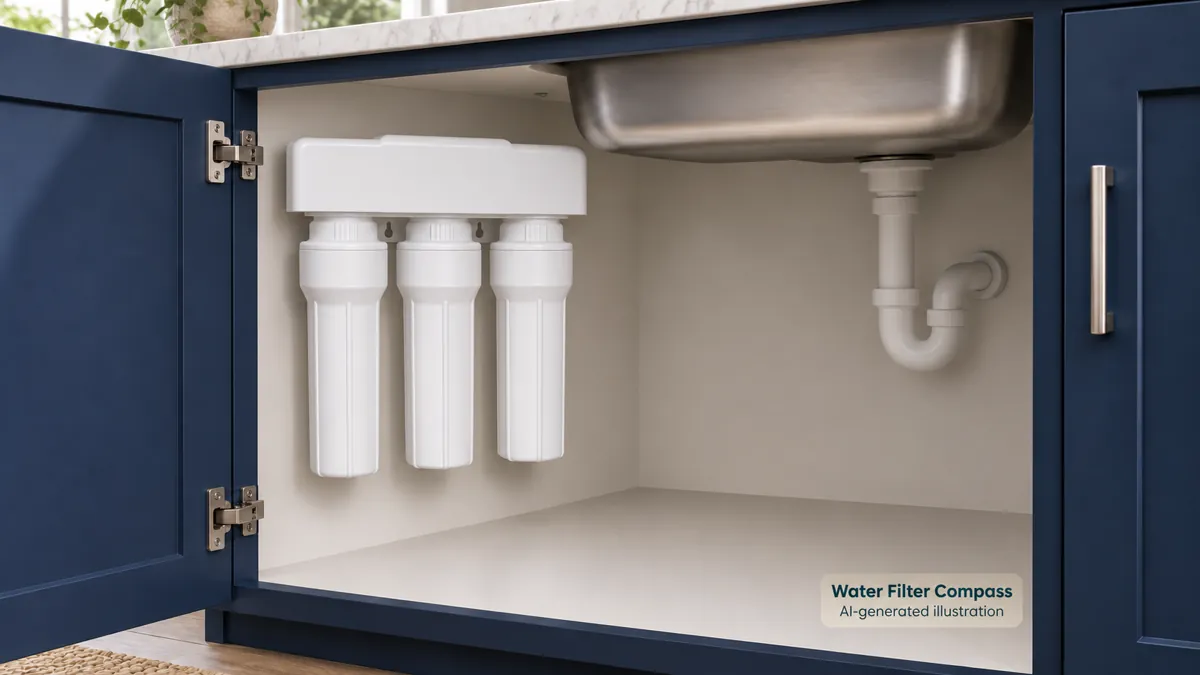
Measure the cabinet before comparing sale prices. Note the shutoff valve, disposal, drain pipes, and the clearance needed to remove each cartridge. Check whether you have an appropriate opening for a dedicated faucet and whether countertop work is needed.
For each RO candidate, check its drain arrangement, tank dimensions or tankless-unit footprint, power requirements, and service access in the installation manual. Do not assume that every RO system requires an electrical outlet or that a tankless system requires no cabinet space.
Request an installation quote for your specific layout. If you rent, obtain permission for permanent changes before purchasing. If the arrangement will block future cartridge changes, resolve that before the installer leaves.
Wastewater: compare the complete ratio
EPA explains that RO produces both treated water and a reject stream. Efficiency varies. WaterSense-labeled point-of-use RO systems must send no more than 2.3 gallons to drain for each gallon of treated water produced.
Be careful with ratio wording: “two gallons purified per gallon to drain” is very different from “two gallons to drain per gallon purified.” Read which quantity comes first, the test conditions, and whether flushing is included.
For an illustrative calculation, a system producing two gallons of drinking water daily, with two gallons rejected per gallon produced, would send four gallons daily to drain before any extra flushing. This is a calculation example, not a rating for a recommended product.
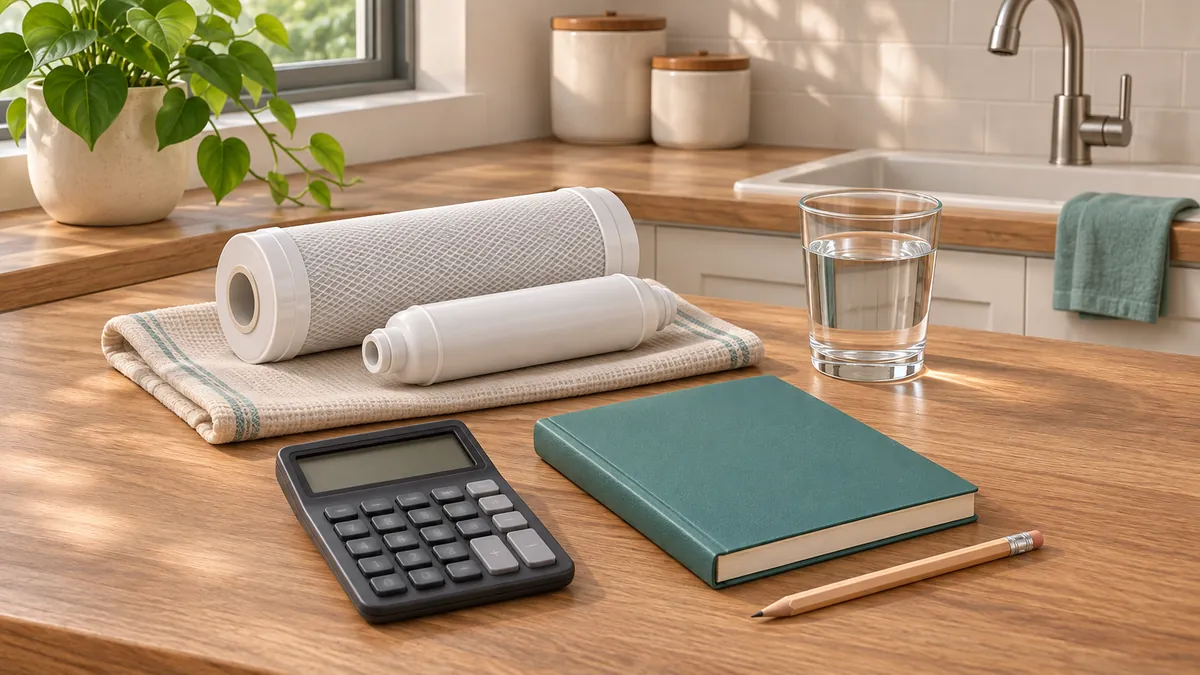
Compare ownership costs before choosing.
Aquasana states a replacement interval of up to six months or 800 gallons for Max Flow. Budget for the earlier limit and follow the manual. An RO system may have separate schedules for its carbon cartridges, membrane, and remineralizer.
Build a three-year estimate using the exact packages you are considering:
- System price, including the correct faucet and first filter set.
- Installation and any electrical or countertop work.
- Replacement parts due during the three years.
- Water and sewer charges associated with RO reject water.
- Longer-term housing or other service requirements in the manual.
Use current replacement prices rather than a first-order subscription discount that may not continue. A lower initial system price can become less appealing when cartridges, shipping, and service are added.
Which option fits your situation?
| Your situation | Your next step |
|---|---|
| Your concern is covered by the AQ-6300M’s documented claims | Compare Claryum’s installation and replacement costs against suitable alternatives. |
| You want fluoride or substantial TDS reduction | Look for an RO model with the relevant documented performance. |
| You have unknown well-water quality | Arrange appropriate testing and treatment advice before choosing either. |
| Your concern affects every fixture | Assess whole-home treatment separately from drinking-water filtration. |
| You cannot make plumbing changes | Compare non-installed options and their exact reduction claims. |
If Claryum meets your requirements, check the AQ-6300M-BN package on Amazon. For an RO candidate already covered in our buying guide, view the Waterdrop G3P600 listing. These are shopping links, not a claim that either system is the right choice without checking your water and the current documentation.
Frequently asked questions
Is Aquasana Claryum reverse osmosis?
Claryum 3-Stage Max Flow is not an RO system. Claryum is also used alongside RO in some Aquasana products, so the exact model matters. Do not transfer one product’s claims to another.
Will a lower TDS number tell me which filter is safer?
No. TDS does not identify which individual substances are present. Match testing and documented reductions to your concern, rather than using a single meter reading to rank safety.
Can I use either option for untreated well water?
Do not assume either is a complete treatment plan. Well-water testing, microbial risks, and the product’s permitted feed-water conditions need to be assessed first. Follow local public health advice and any drinking water advisories.
Do I need both Claryum Max Flow and a separate RO system?
Not automatically. Some RO products already incorporate carbon and other filtration stages. Adding two complete systems increases parts and maintenance; establish a documented treatment need and compatibility before doing so.
The purchase decision
Choose the system whose verified claims address your water concern and whose maintenance you can keep up with. Claryum Max Flow can be a candidate for selective filtration; RO deserves comparison when you need a treatment capability the Max Flow sheet does not list.
Before ordering, read the full Max Flow review for its product-specific costs and maintenance considerations, or use our seven-filter comparison to explore other installation types.
Sources and research
- Aquasana performance data sheets: select AQ-6300M and the exact RO model
- Aquasana Claryum 3-Stage Max Flow product and maintenance information
- CDC: About Choosing Home Water Filters
- EPA WaterSense: Point-of-Use Reverse Osmosis Systems
- NSF: Standards for Water Treatment Systems
- Health Canada: Drinking water treatment
Documentation checked November 3, 2026. Product specifications, packages, and prices can change. Our editorial policy explains how we research content.
1 thought on “Aquasana Claryum vs Reverse Osmosis: Which Fits Your Water?”